 The adverse impacts of climate change are no longer confined to scientific forecasts; rather, they are severely disrupting the social, economic, and demographic fabric of our daily lives. A national consultative meeting recently organized by Caritas Bangladesh at the Dhaka Reporters Unity (DRU), titled “The Role of Mass Media in Advancing Appropriate Policies for Climate Migrants,” brought the multifaceted dimensions of this crisis to the forefront. On one hand, direct climate impacts are severely impairing the biological and developmental trajectories of unborn and newborn children. On the other hand, millions of climate refugees displaced to urban centers face a severe crisis regarding their civic rights and social security. Formulating an effective national policy and securing a robust role for the media to address this dual crisis is now the demand of the hour.
The Invisible Crisis and the Cycle of Deprivation:
The discussions at the Caritas consultation identified the crisis of climate migrants as “multifaceted and invisible,” a sentiment that directly aligns with global scientific and analytical frameworks. Those forced to leave their ancestral homes due to environmental degradation and take refuge in urban slums—particularly in a megacity like Dhaka—fall into a severe cycle of civic disenfranchisement.
Because their permanent addresses remain in their rural villages according to their National Identity Cards (NID), they are structurally excluded from state-sponsored social safety net programs upon migrating to the city. Consequently, children and expectant mothers bear the heaviest burden. Deprived of basic healthcare, clean water, and education—while living in unsanitary slums exposed to extreme heatwaves—these children are driven toward chronic malnutrition and long-term physical and cognitive disabilities. Economic deprivation does not merely collapse a single family; it weakens an entire generation at its baseline.
Media Information Gaps and Structural Limitations:
Mass media serves as the primary vehicle for bringing this profound crisis to the attention of policymakers. However, during the consultation, senior journalist and essayist Dr. Dipu Siddiqui highlighted a critical truth. He noted that while the media features an abundance of sports and entertainment news, there is a distinct lack of deep, data-driven reporting on the long-term crisis of climate migrants, gaps in government policy, and scientific consequences.
Due to a lack of comprehensive and timely information, this humanitarian disaster is not receiving the visibility it deserves among policymakers and the public. To bridge this information gap, an environment that supports investigative journalism must be cultivated. Establishing dedicated media networks and fellowship programs for interested journalists is essential to regularly amplify the stories of coastal “climate warriors” and the sensitive realities of climate-induced childhood disabilities.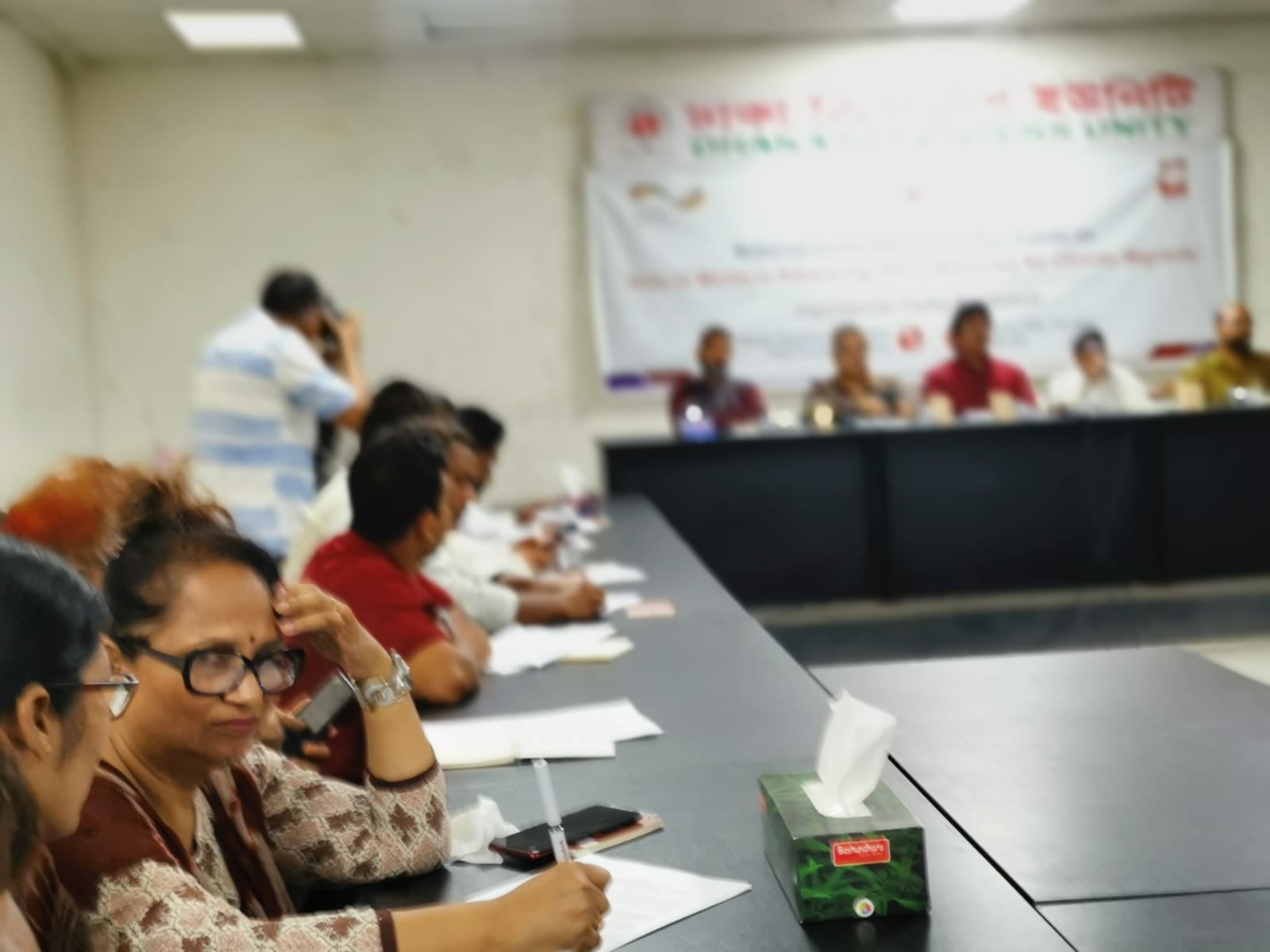
The Funding Void and Lack of Sustainable Technology:
According to executive members of the Bangladesh Federal Union of Journalists (BFUJ), foreign grant assistance for climate adaptation has decreased significantly since Bangladesh transitioned into a lower-middle-income status. Paradoxically, the risks and frequencies of climate-induced disasters continue to escalate daily. To address this financial and structural void, maximizing internal resources and strictly preventing waste in public development projects is imperative.
Furthermore, the lack of modern, green technologies in industrial production and waste management allows toxic chemicals to leach into water bodies and agricultural lands. As heavy rainfall and floods intensify, these industrial contaminants are spread across wider residential zones. As Alexander Tripura, Head of the Disaster Management Department at Caritas Bangladesh, reminded the audience: although Bangladesh’s role in global carbon emissions is negligible, it remains one of the worst victims. Therefore, strict transparency in utilizing global climate compensation funds must be enforced to directly safeguard the health of vulnerable mothers, children, and displaced populations.
Policy Recommendations and Conclusion:
The national consultation by Caritas Bangladesh delivers a clear message: climate-induced displacement and the resulting health risks of the future generation are not isolated issues. They must be integrated into a comprehensive national roadmap.
1. Dedicated Institutional Framework: A separate ministry, division, or dedicated institutional cell should be considered to streamline the rehabilitation, housing, education, and healthcare of climate-displaced people.
2. Policy Modernization: National safety net policies require urgent revision to ensure that climate migrants instantly access social security, maternal care, and basic civic facilities at their new urban destinations, regardless of their original permanent addresses.
3. Research-Driven Prevention: Substantial budgetary allocations must be directed toward deep scientific research to map the exact chemical, thermal, and nutritional pathways through which environmental shifts cause fetal harm, shifting the approach from reactive treatment to primary prevention.
Confronting the multi-layered shock of climate change requires a synchronized, multi-sectoral effort uniting the government, mass media, and civil society organizations like Caritas. Securing the physical and cognitive safety of our children is not merely an environmental obligation; it is a core prerequisite for sustaining human progress and global equity.
Author: Dr Dipu Siddiqui , Researcher and media personality.